Carpenter Ant Season in BC: When Do Fraser Valley Homeowners Need to Worry?

Understanding Carpenter Ant Activity in the Fraser Valley
Carpenter ant season in BC is already underway, and many Fraser Valley homeowners only recognize it once visible signs begin to appear. By then, a colony may have been active inside or around the home for months. Carpenter ants are not typical nuisance pests; their nesting habits can lead to severe structural damage over time.
This guide explains when carpenter ants become active, why the Fraser Valley creates ideal conditions for them, how to identify early warning signs, and what steps to take before the problem becomes more serious.
When Is Carpenter Ant Season in BC?

Carpenter ant season in BC typically begins when temperatures consistently rise above 10°C, which usually happens in late March or early April across the Fraser Valley. At this point, colonies that have been dormant through winter begin foraging again. Activity peaks between April and June, although lower-level activity can continue through the summer.
It is important to understand that carpenter ants do not disappear during winter. They remain inside their nests and become active again once conditions allow. This means that seeing ants in spring rarely indicates a new infestation. More often, it signals a colony that has already been established and survived the winter.

The Temperature Trigger: When Colonies Wake Up
The key threshold for carpenter ant activity is sustained temperatures above 10°C. Once reached, worker ants begin searching for food sources, often becoming visible indoors or around the home.
Carpenter ants are primarily nocturnal. Homeowners often notice them in the early morning or late evening, especially in kitchens, bathrooms, or along baseboards. Their presence at this stage usually reflects an established foraging pattern rather than a random occurrence.
In the Fraser Valley, mild winters allow colonies to survive year after year. This is one reason that local pest control companies like The Bugman have extensive experience tracking seasonal patterns across communities such as Abbotsford, Chilliwack, and Langley.
Swarmer Season: What Winged Ants in Your Home Actually Mean
Winged carpenter ants, often called swarmers, emerge from mature colonies to reproduce. In the Fraser Valley, this typically occurs between late March and May.
Seeing winged ants indoors is one of the clearest signs of an established infestation. These swarmers only develop in colonies that are at least two to three years old. If they are appearing inside your home, the colony is already well-developed and likely located within or directly adjacent to the structure.
This is also one of the most misunderstood signs. Many homeowners assume they are seeing harmless flying ants or even termites. In reality, swarmers indicate a mature colony that requires immediate attention.
Why the Fraser Valley Is Carpenter Ant Country
The Fraser Valley consistently ranks as one of the highest-risk regions in Canada for carpenter ants. The combination of climate, construction materials, and surrounding environment creates ideal nesting conditions.
Annual rainfall in our region often exceeds 1,500 mm, keeping wood structures damp well into spring. Moisture plays a critical role in carpenter ant behaviour, as it softens wood and makes excavation easier.
Mild winters also allow colonies to survive without interruption, leading to long-term population growth rather than seasonal die-off.
The Role of Rainfall and Moisture in Structural Wood
Canada Conservation Institute, prolonged exposure to moisture significantly weakens structural wood, making it more vulnerable to biological and insect-related damage.
Common problem areas include:
- Roof leaks and poorly sealed flashing
- Condensation in crawl spaces or attics
- Plumbing leaks under sinks or behind walls
- Aging window and door frames
Once a colony establishes itself in softened wood, it can expand into surrounding structural materials, including framing, joists, and roof components.

Why Wooded Neighbourhoods Face Higher Risk
Homes located near wooded areas face increased exposure to carpenter ants. In communities such as Abbotsford, Mission, Chilliwack, Langley, and Maple Ridge, it is common for parent colonies to exist outdoors in tree stumps, logs, or dead trees.
From there, ants create satellite colonies inside nearby structures.
Common entry pathways include:
- Tree branches touching the roof
- Firewood stacked against exterior walls
- Direct wood-to-soil contact around foundations
The Bugman serves all of these Fraser Valley communities, with technicians who understand the local environmental conditions and typical infestation patterns.
How to Identify Carpenter Ants
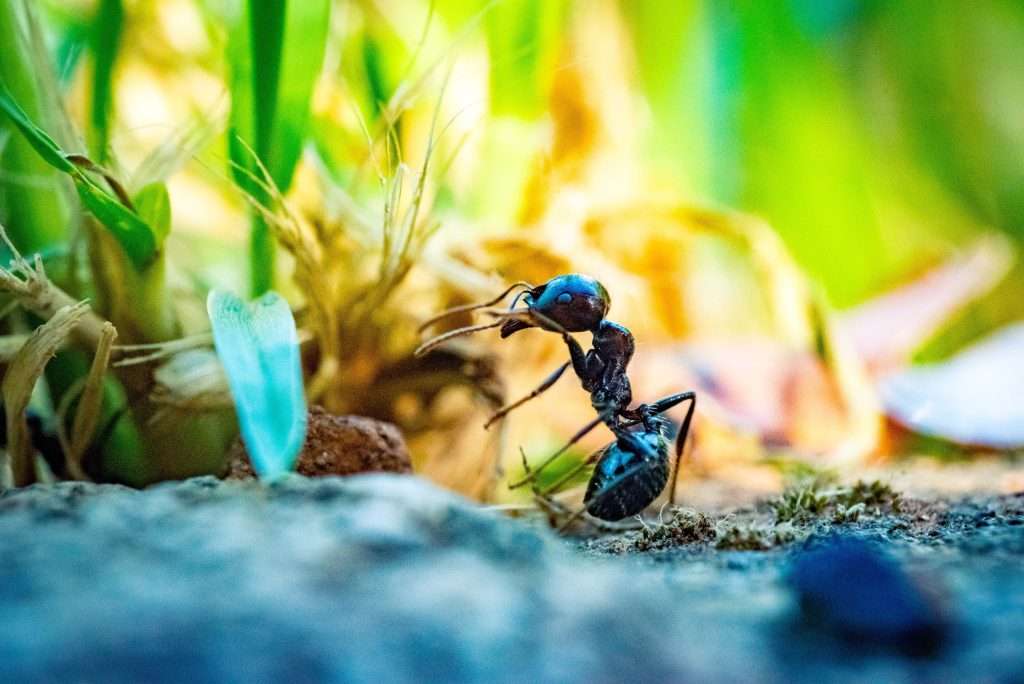
Accurate carpenter ant identification is critical before attempting any treatment. Misidentifying them as smaller household ants or termites often leads to ineffective solutions.
Carpenter ants in BC typically range from 6 mm to 17 mm in length. They are significantly larger than common pavement ants and often have a shiny black appearance, though some species display red or orange colouring.
Key identification features include:
- A single-node waist
- Elbowed antennae
- A smooth, rounded thorax when viewed from the side
- Varying sizes within the same colony
Carpenter Ants vs. Termites: Telling Them Apart in BC
Carpenter ants are frequently mistaken for termites, but the two differ in several important ways.
As explained by the University of Minnesota Extension, carpenter ants have a narrow, pinched waist and bent antennae, while termites have a broad body and straight antennae. Winged carpenter ants also have uneven wing pairs, with front wings larger than the back.
Another key difference is behaviour. Carpenter ants excavate wood and leave behind frass, while termites consume wood and often create mud tubes.
In the Fraser Valley, termites are relatively uncommon, making carpenter ants the primary structural pest concern.
Carpenter Ants vs. Black Ants: Size and Shape Differences
Pavement ants and other small black ants are much smaller, usually between 1.5 mm and 4 mm. They also have a two-node waist and do not tunnel through wood.
If you are seeing large black ants indoors, particularly near wooden structures or moisture-prone areas, carpenter ants should be strongly suspected.
Warning Signs of a Carpenter Ant Infestation in Your Home
Recognizing the signs of carpenter ants early can prevent significant damage. The following indicators are among the most reliable:
- Frass deposits: Coarse, sawdust-like material mixed with debris found near baseboards, window frames, or wooden structures
- Rustling sounds in walls: Faint noises, especially at night, caused by ants excavating galleries
- Winged ants indoors: The presence of swarmers is a strong indication of a mature colony
- Discarded wings: Small piles of wings near windows or doors after swarmers have shed them
- Nighttime activity: Large ants foraging along counters, walls, or floors after dark
- Hollow or damaged wood: Tapping on wood that produces a hollow sound or reveals smooth internal tunnels
If you are unsure whether what you are seeing qualifies as a carpenter ant infestation, The Bugman offers in person consultations to assess the situation accurately.

How Long Before Carpenter Ants Cause Real Damage?
Carpenter ants do not cause damage as quickly as termites, but their impact can still be significant over time.
A colony left untreated for three to five years can weaken key structural components, including floor joists, wall framing, and roof supports. The challenge is that most damage occurs inside the wood, remaining hidden until it becomes severe.
Swarmers are a particularly important signal. Their presence indicates that a colony has already reached a mature stage, meaning excavation has likely been ongoing for years.
While it is rare for carpenter ants to completely destroy a home, the cost of repairs can become substantial if the infestation is ignored. Early intervention is consistently more cost-effective than structural restoration.
What You Can Do Right Now: Prevention for Fraser Valley Homeowners
Preventing carpenter ants starts with addressing the conditions that attract them.
Focus on moisture control first. Repair roof leaks, fix plumbing issues, and improve ventilation in crawl spaces and attics. The Government of British Columbia provides guidance on managing carpenter ants, emphasizing moisture reduction as a primary prevention strategy.
Additional steps include:
- Remove wood-to-soil contact around foundations
- Store firewood at least 6 metres away from the home
- Trim branches that touch the roof or walls
- Seal gaps around windows, doors, and utility entries
- Keep food sealed and surfaces clean indoors
- Remove stumps, logs, and wood debris from the yard
These steps help reduce the likelihood of an infestation but are not a substitute for treatment if carpenter ants are already present. For ongoing protection, The Bugman offers year-round maintenance programs designed to prevent recurring issues.
Why Choose The Bugman for Carpenter Ant Control in the Fraser Valley
Understanding the risks and warning signs is important, but once an infestation is established, professional treatment is necessary.
The Bugman brings over 30 years of experience across BC, with deep familiarity in Fraser Valley pest pressures. Our local technicians live and work in the communities they serve, including Abbotsford, Chilliwack, Langley, Mission, Maple Ridge, Aldergrove, Agassiz, and Hope.

Key advantages include:
Local expertise based on real regional conditions
Family-run business led by Bryce Clark, continuing a multi-generational legacy
Safe products suitable for homes with children and pets
Fast response times, including urgent situations
Ready to protect your home from carpenter ants? Contact The Bugman today for a free quote.
Don’t Wait Until the Damage Is Visible
Carpenter ant season in BC is already in motion across the Fraser Valley, and early signs should never be ignored. Colonies develop quietly, and the longer they remain untreated, the more damage they can cause. Whether you have noticed swarmers, frass, or unusual activity, addressing the issue early is the best way to protect your home.
Ready to get started? Contact The Bugman today for a free quote.
Table of Contents
Related Blogs


Frequently Asked Questions About Carpenter Ants in BC
When does carpenter ant season start in the Fraser Valley?
Carpenter ant season in BC typically begins in late March to early April, once temperatures rise above 10°C. Activity increases through spring and often continues into summer due to the region’s mild climate.
What do carpenter ants look like, and how do I tell them apart from termites?
Carpenter ants are large, usually black, and have a narrow waist with elbowed antennae. Winged individuals have uneven wing pairs. Termites have straight antennae, equal wings, and a broader body.
Are carpenter ants dangerous to my home’s structure?
They do not eat wood, but they excavate it to create nesting galleries. Over several years, this can weaken structural components and lead to costly repairs.
Can I get rid of carpenter ants myself?
DIY methods may address minor activity but rarely eliminate the entire colony. Effective treatment requires locating and removing the source, which often involves professional-grade products and techniques.
Why do I have carpenter ants in my Fraser Valley home?
Moisture is the primary attractant. Homes with damp wood, nearby trees, or structural vulnerabilities are more likely to develop infestations, especially in wooded areas.